AI Product Design · B2B SaaS · Workflow Automation · AI Assistant Architecture · interaction Design · UX Strategy · Design Systems · Prototyping

TL;DR
Hired to kick off AI at Capmo, I defined the AI mental model, identity, and interaction architecture from the ground up.
After repositioning AI from a hidden experimental feature into a task-oriented assistant embedded in core workflows, I led the design of AI-enabled reporting and automation (speech-to-structured updates, summarization), ensuring it addressed executive priorities and was embedded in real workflows.
The outcome was a scalable AI foundation, not isolated features, embedding intelligence into everyday construction workflows.
✦
context & AI opportunity
✦
role & scope
Defined the AI mental model, positioning, and interaction architecture (global assistant + embedded automation).
Designed onboarding patterns for non-technical users to reduce cognitive load and support adoption.
Led UX/UI for AI-enabled workflows, including speech-to-structured reporting and summarization.
Partnered with Product and Engineering on AI strategy, capability scoping, and implementation.
Ensured system-level consistency across adjacent product areas (e.g., Project Profile, Approval Flows, Plan Management).
theme 1
defining the AI mental model
Before defining features, we defined the role AI should play in Capmo.
Three directions were possible: a smarter search layer, a conversational AI companion, or a task-oriented digital assistant. Based on research in construction environments, we chose the latter.
Construction professionals work under time pressure with complex project data, prioritizing outcomes over exploration. An open-ended chat model would add cognitive load, a search-only solution would limit impact and scattered AI features risked confusion.
Capmo AI was therefore designed as a task-specific assistant for structured work. Architecturally, this meant a globally accessible assistant to build trust, with progressive contextual embedding.
Two interaction layers emerged:
A global assistant for cross-area reasoning and multi-step requests
Embedded, in-context automation for focused workflow tasks
This dual model creates a coherent path from visible entry point to deep workflow integration without losing clarity or control.
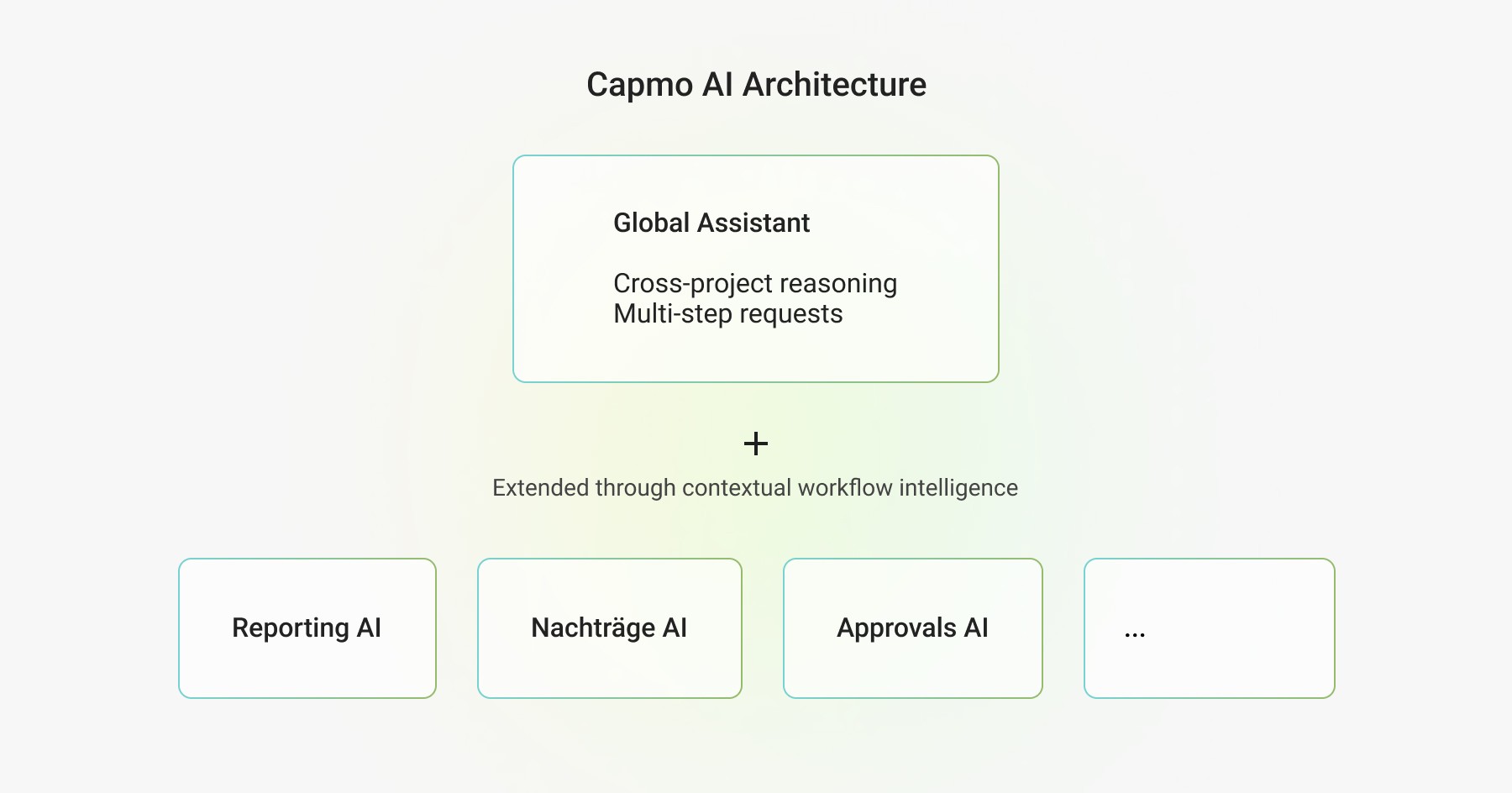
A globally accessible assistant, extended through contextual workflow intelligence.
personification & brand
With the mental model set, the identity had to support it. We avoided anthropomorphic framing or playful names. Instead of a “companion,” the system is simply Capmo AI, clearly anchored in the product ecosystem.
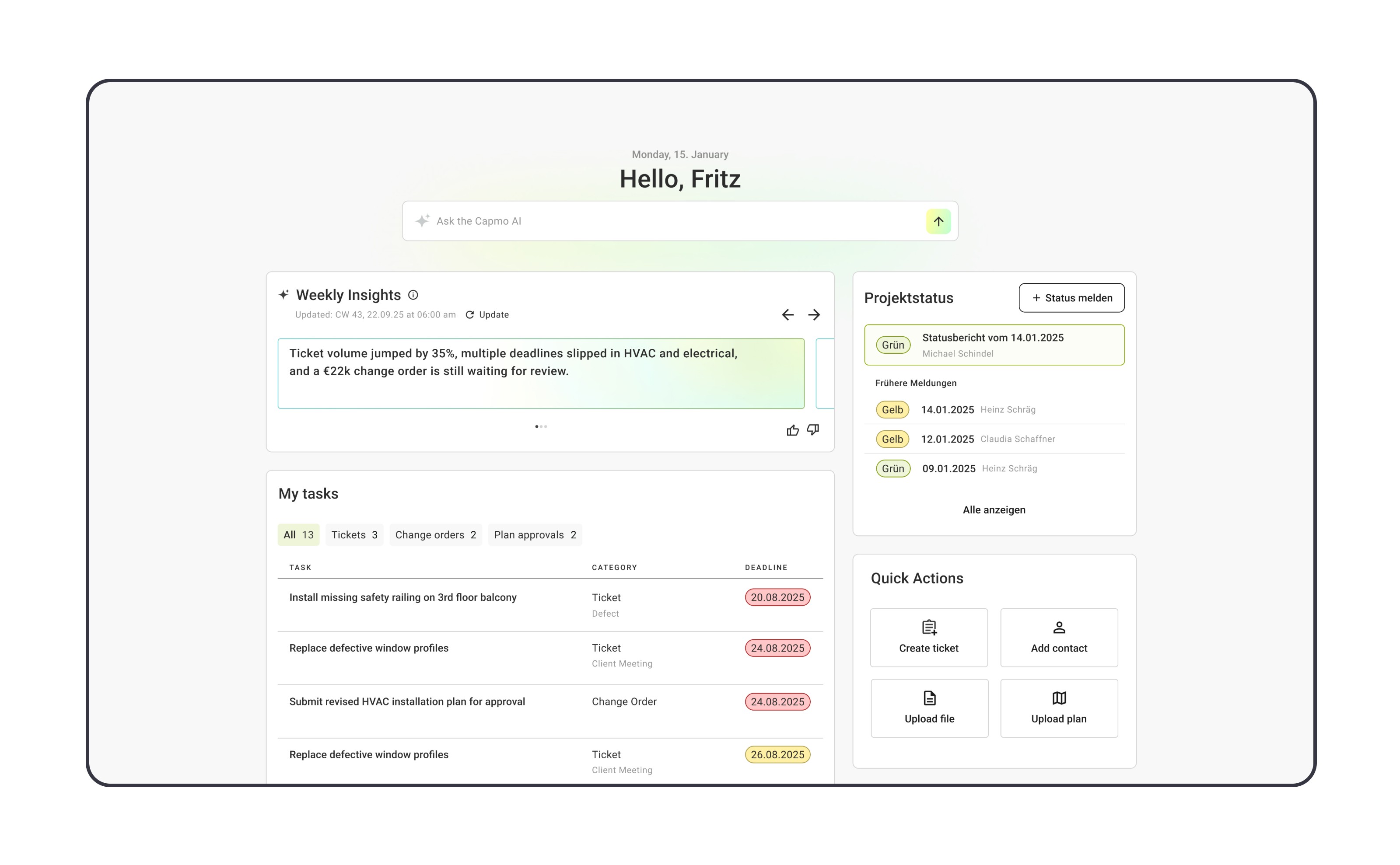
The symbol was a key decision. After exploring proprietary directions, I intentionally chose a minimal star form, a visual language familiar from other AI systems like Gemini. Over-branded or novel icons would have added friction and required users to relearn a pattern. Since the icon appears across CTAs, labels, and workflows, clarity and recognizability took priority over uniqueness.
The broader visual system (gradient, adaptable shape, and motion) functions as product material: recognizable as an AI entry point, yet subtly to embed seamlessly within workflows. The tone of voice is precise, professional, and solution-focused, guiding users without over-personalizing, reinforcing trust in the B2B construction environment.
onboarding non-technical users
Many Capmo users are domain experts but not early AI adopters. Presenting AI as an empty chat field would leave its value invisible and the first step unclear.
Instead of expecting users to figure out prompting, we introduced structured scaffolding:
Clear global entry points
Contextual suggestions tied to real tasks
In-flow nudges embedded directly into workflows
Rather than relying on a static tutorial, the system supports users at the moment of need. By guiding first interactions and progressively embedding automation into daily work, AI becomes practical and approachable, not abstract.
Together, the mental model, identity system, and onboarding patterns established AI not as an isolated feature, but as a coherent product layer that scales into deeper contextual automation.
theme 2
embedding AI into core workflows
the strategic trigger
Capmo created strong operational value for construction managers, but managing directors didn’t see the direct value. This became visible in sales conversations: site-level efficiency didn’t translate into executive control.
Managing directors care about:
Margin protection
Early risk detection
Portfolio visibility
At the time, Capmo lacked a lightweight reporting layer to turn operational activity into structured executive insights. Documentation existed, but no abstraction.
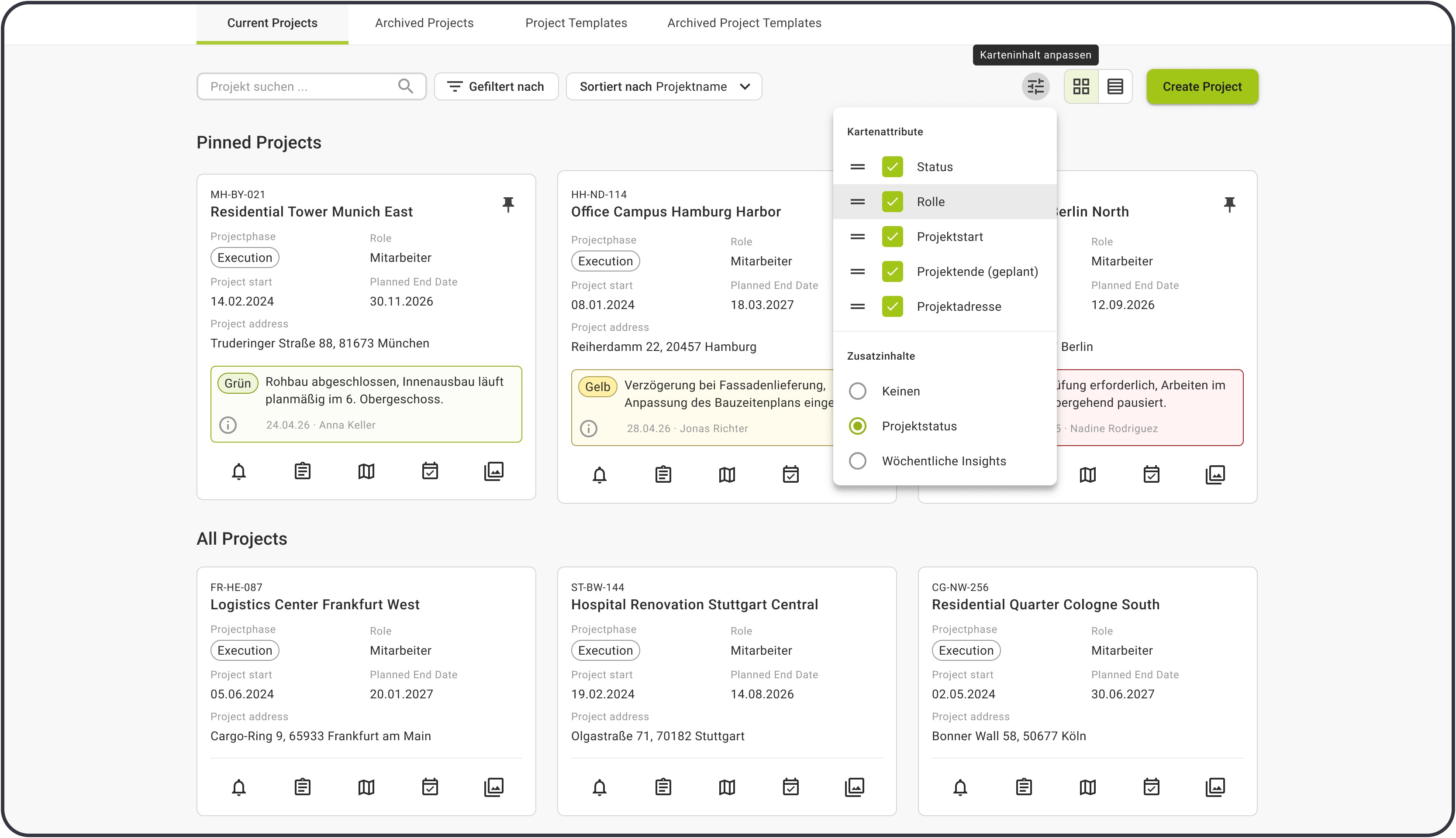
The initiative was to provide simple project status updates, show trends, and lay the foundation for a portfolio dashboard. For it to succeed, reporting had to be easy to adopt and structured enough to compare.
AI only became the enabler once its role was clearly defined.
the evolution: from helper to agent
The AI integration didn’t start as a reporting agent. The first idea was to generate suggestive bullet points in the description field to reduce blank-page anxiety and help users write fuller updates.
It improved wording, but not workflow. Next, speech-to-text reduced typing effort but still produced unstructured content. Combining speech input with AI refinement and template formatting brought clarity and structure, but it was still incomplete.
The breakthrough came when we stopped focusing on the description field. Instead of assisting writing, AI would generate the structured report object itself.
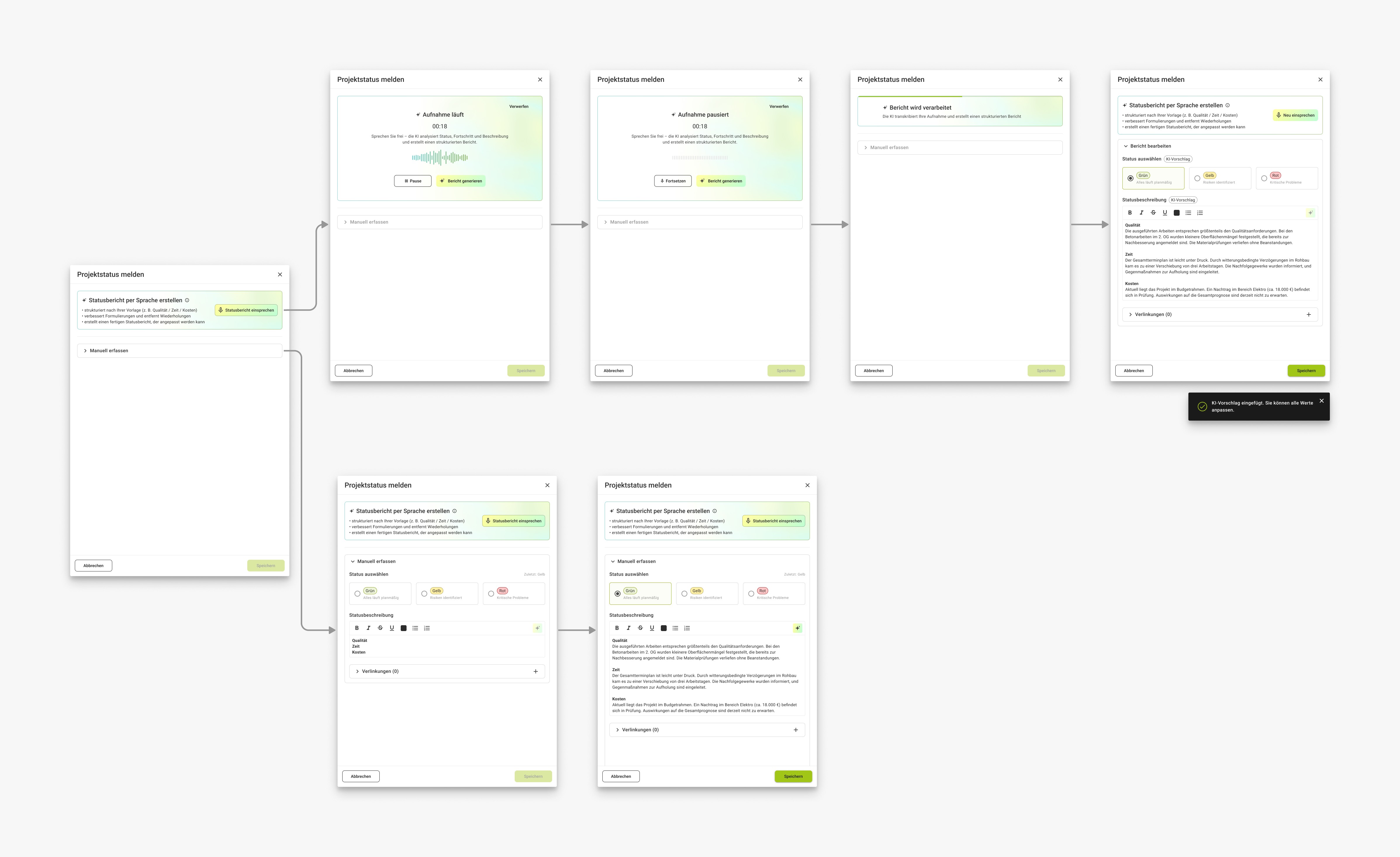
After speech input, the system now:
Transcribes the update
Applies the predefined template
Improves clarity and tone
Extracts overall status (green/yellow/red)
Extracts cost, time, and quality signals
Reporting became Speak → Review → Confirm, replacing the old Write → Improve → Structure → Manually classify workflow. This was the moment AI shifted from enhancement to transformation.
designing the trust boundary
Turning AI into a reporting agent introduced a new risk: loss of control. In construction, accountability matters and status updates affect decisions and financial oversight.
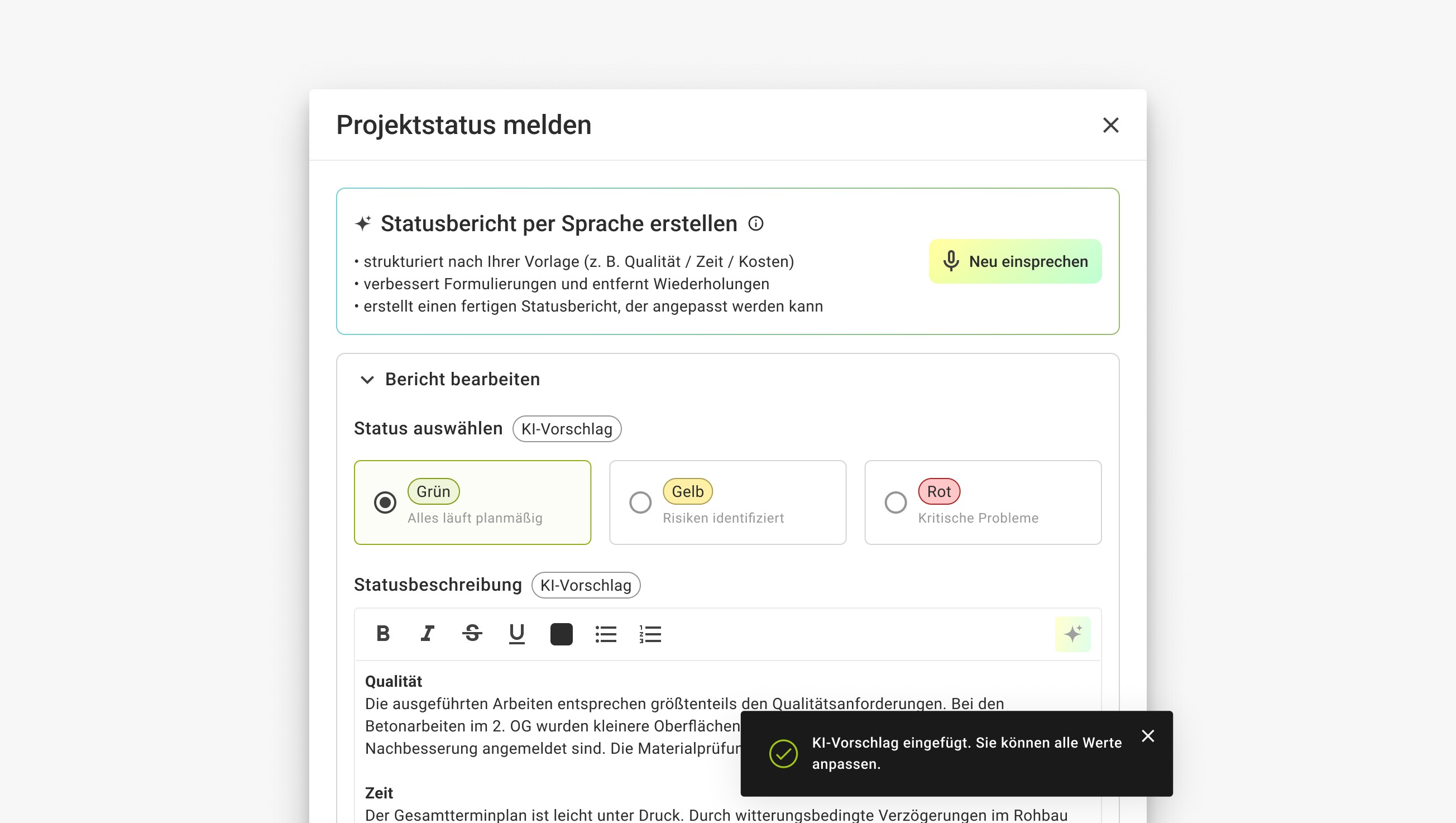
The most delicate moment occurs after speech processing. We designed the interaction around a clear boundary: AI proposes → user reviews → user edits → user owns.
Key decisions:
Extraction happens only after stopping, no live interference.
Structured fields are prefilled but visibly marked as AI-generated.
Once edited, the AI badge disappears (ownership transfers silently).
Regeneration requires explicit overwrite confirmation.
Empty and partial extraction states are handled explicitly.
No AI confidence scores, to avoid false precision
AI does not submit or decide; AI proposes.
This boundary keeps the construction manager as the author, preserving psychological ownership while greatly reducing reporting effort.
outcome
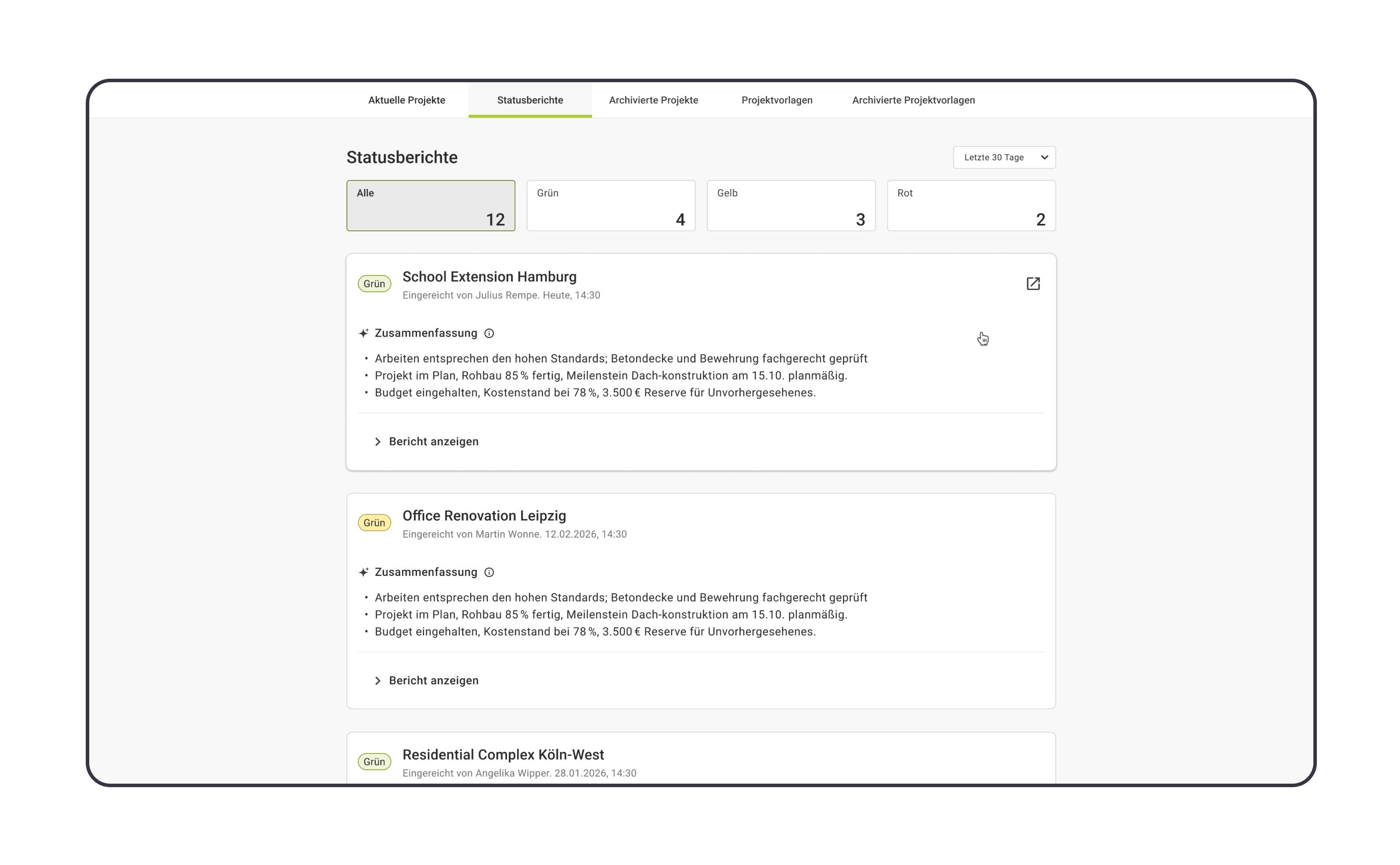
By embedding AI at the point of signal creation, we:
Reduced friction in reporting
Standardized project health inputs
Created comparable signals across projects
Enabled the executive portfolio layer
The goal was not to “add AI to dashboards”, it was to transform reporting into a structured signal system creating direct value for managing directors.
impact
Defined a coherent AI product layer in Capmo: from mental model and identity to embedded automation.
Developed AI from writing assistance into structured workflow automation (e.g., reporting agent).
Established the first standardized signal layer enabling executive project and portfolio visibility.
Reduced reporting friction while preserving accountability through a clear proposal–confirmation model.
Embedded AI into real tasks to establish usage baselines for future adoption optimization.
Ensured cross-feature consistency by leading UX/UI across adjacent initiatives (project profile, approval flows, plan management).